A Sense of Belonging

Photography: Priscilla Harmel

When I was 6 years old, my family moved us from one home / neighborhood /school to another. It wasn't a very big move and yet, it was enormous. In my memory, the move impacted me so that I was transformed from a fairly confident child to a wallflower, shy and insecure. When the teacher asked us to choose a partner for anything - a spelling partner, a dance - I was always the last one chosen. No one chose me. Never mind that it took me to adulthood to realize I could have made the choice. On the playground, I was always relegated to holding one end of the jumprope, not one of the jumpers. All of this further eroded my self-confidence and feeling of belonging.

So it's not surprising that I noticed when others seemed to fade into the wood work also. That seemed to be the group I belonged to. Later, working with adults in cardiac rehab as a stress management therapist, I saw the ways that even firefighters and CEOs demonstrated a lack of confidence, belittling themselves when they "couldn't even blow bubbles". (This was how I taught pursed lip breathing.) Fast forward to leading dance/movement therapy groups in a nursing home. The groups happened in a common space, but some people were referred and others not. (What a terrible system!) It seemed to me that the people on the outskirts may have felt excluded and that never felt okay to me. So I attempted to include all who were present.

I found my sense of belonging in Barbara Mettler's Creative Dance classes. It was Mettler's insistence that we each move in our own ways, knowing that we affect one another that seemed to instill that lesson. The most fundamental teaching I received from her was the Scatter Position: Find a space where you have enough room to move and everyone has an equal amount of space. You’re not going to share your space with the wall or any thing or person. If you were to see this space from above, you should see the space equally divided. If you see it is not equal, you are to do what you can to make it more equal. That will then require everyone else to move as well. The message: we are all individuals and part of a collective. What one person does affects the whole. Also, if we see something unequal, it is up to us to make a correction. Every single one of us belongs and matters.

It is that sense of belonging which I attempt to instill in the dance groups I now facilitate with older adults and people with dementia. A sense of belonging makes us feel safe and allows us to express ourselves and whatever is on our hearts and minds. I believe that each of us is here to be who and what we are.

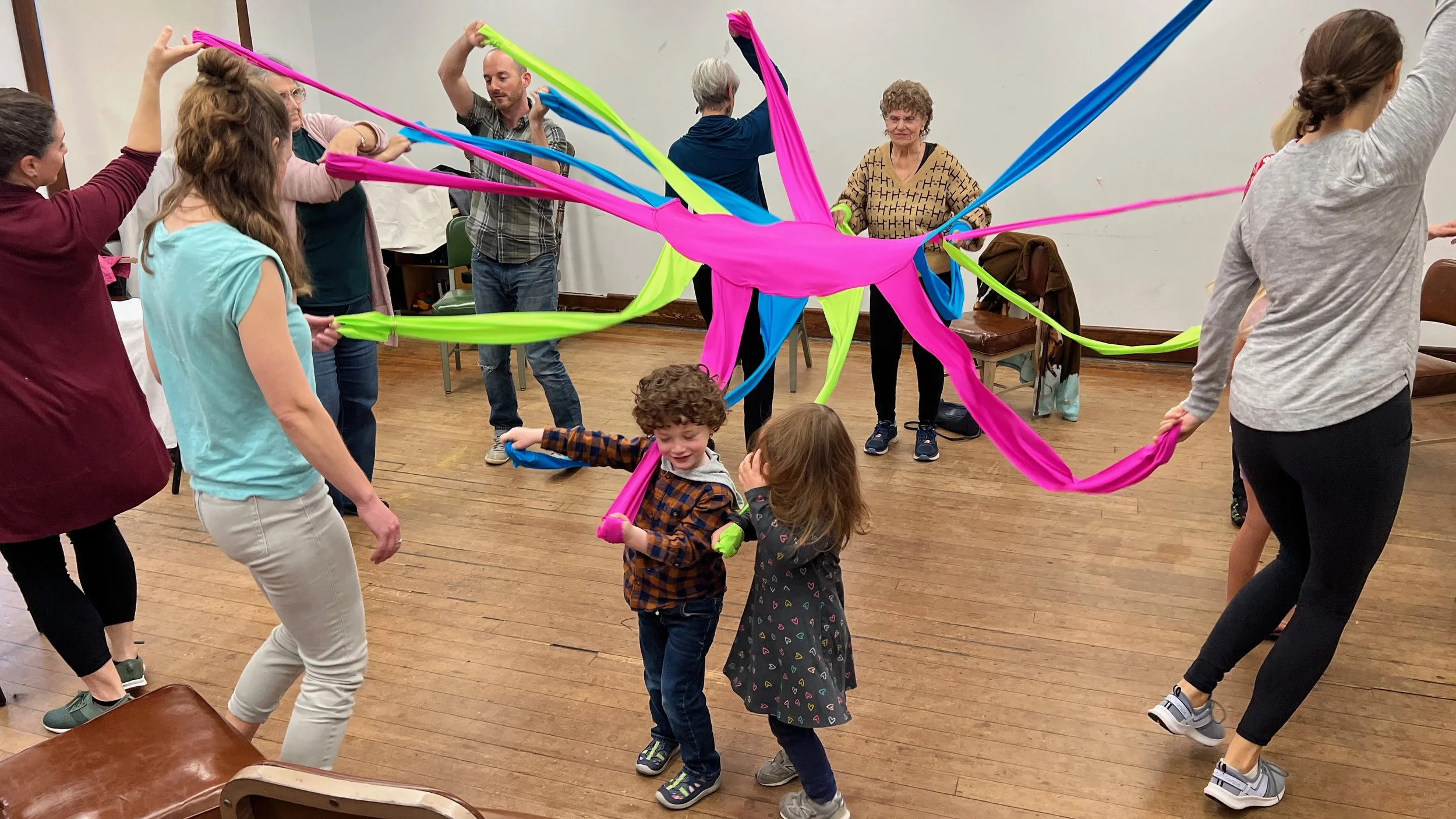
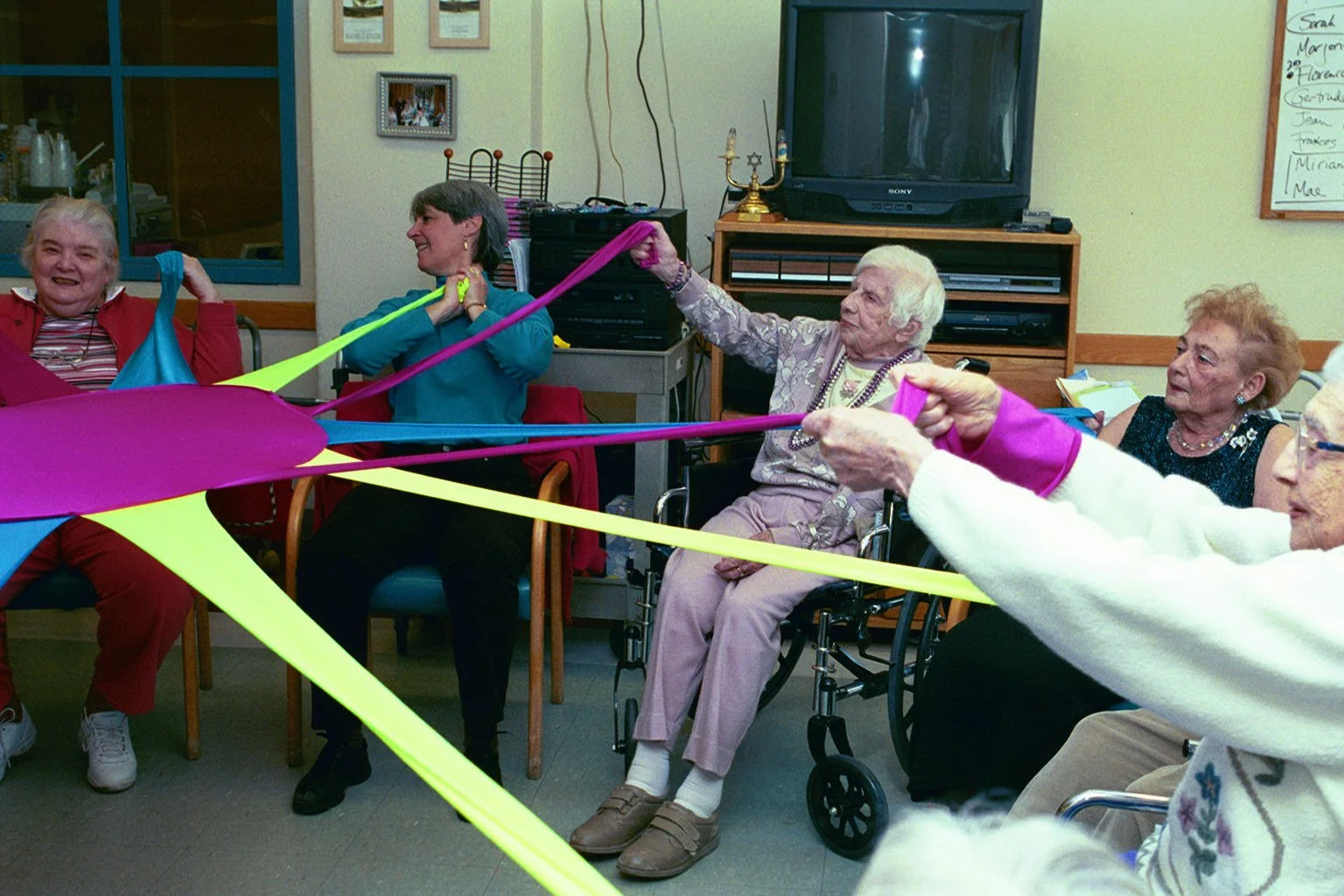
It is that sense of belonging and our responsibility to one another which is manifested in the Octaband® I created.

And it is that sense of belonging that I attempt to instill in my trainings. In my 15 hour training, Bringing Dance to People with Dementia, I attempt to get all of us to be responsible for our own feelings of safety and belonging so that together we can bring that to the people with dementia with whom we dance in two hour-long sessions. I think it is that concept that makes my trainings so special and transformational.

When we embody a concept, we can more easily impart it to others - nonverbally. Or, as Irmgard Bartenieff might say, “Internal connections lead to external expression.”

The earlybird rate for Bringing Dance to Older Adults and People with Dementia, the in-person, 15 hour training in Westwood, MA, April 18-19, has been extended for just a few more days - to April 3. You can find out more here: https://danceforconnection.com/upcoming-events/2019/5/18/training-bringing-dance-to-older-adults-and-people-with-dementia-p68b7

Here is where you register: https://danceforconnection.com/store/training-to-bring-dance-to-people-with-dementia.
Choosing Music for a Dance Group with People with Dementia

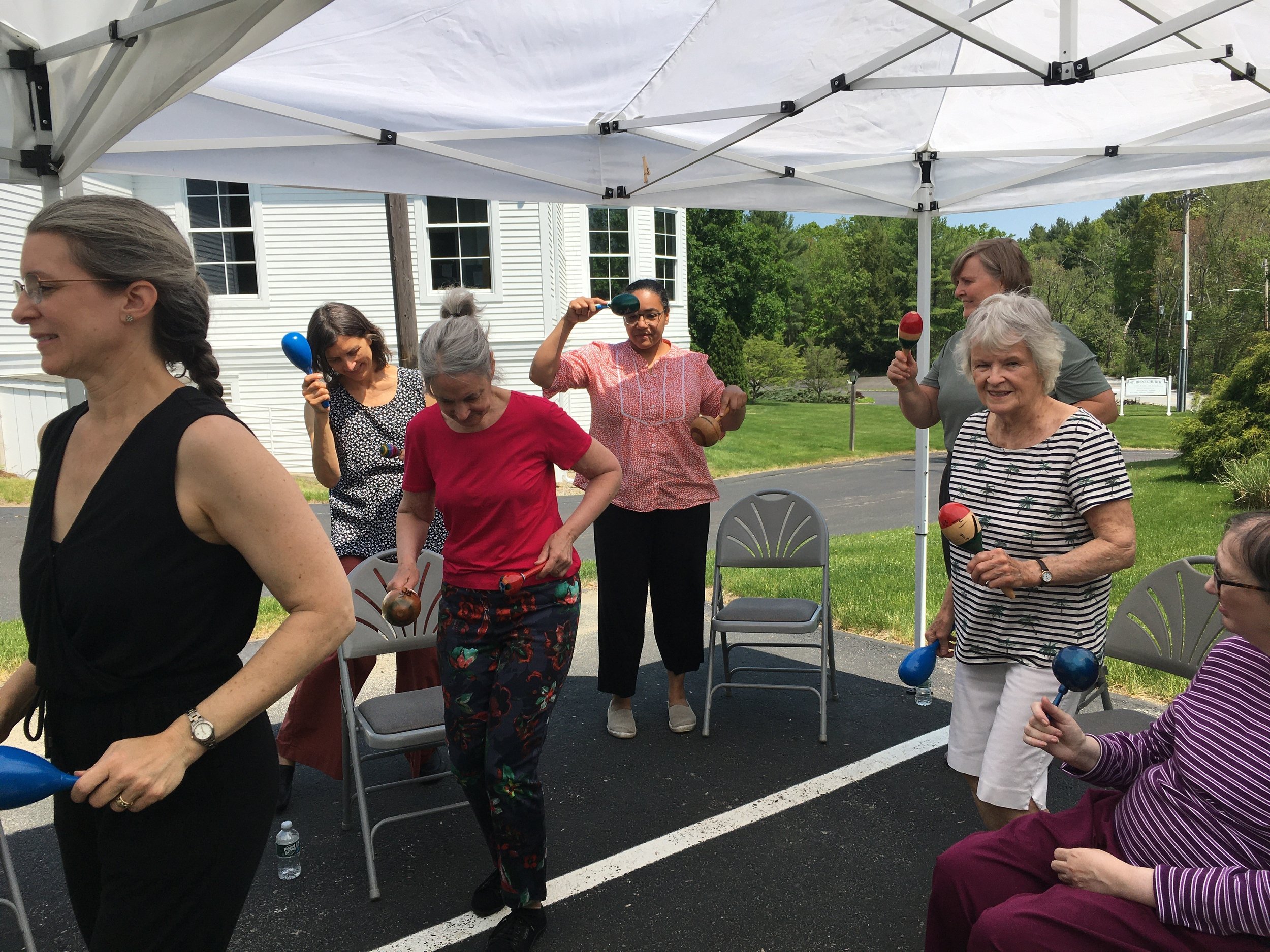
The most frequent request I get is for my playlist. I'm sorry to say, that is not simple. Choosing music for a group - any group, whether for people with dementia, older adults, caregivers, peer dance improvisers - is a time-consuming labor of love. I take the opportunity while choosing music to think about whom I will trying to engage. What do I know about them, their age,  ethnic background, musical preferences? And what music will motivate me to dance today?

Because it's rare for people with dementia to be able to tell me the name of a song they want to hear, choosing music for them is most important. If I know people's ages, I will choose music from when they were 13 to 16 y.o. I always choose music about love because that's the feeling I'd like to project. The  first song I play most frequently is "Can't Help Falling in Love with You" by Elvis Presley because it is well known with lyrics people can sing along to and can get people swaying. Sometimes people cry, remembering it as their wedding song. After the first time that happened, I stayed away from the song for quite a while until I realized that crying iss okay as long as it doesn't leave them in the depths of despair. Sadness is a feeling; it's okay to have a range of emotions during a group. We're flexing our emotional muscles along with our physical ones, as long as it is not causing them distress.

Sometimes, like now with the recent blizzard, I will choose music for the weather. A good song for today would be "Let it Snow!" by Dean Martin. However, I recently used "Summertime" by Ella Fitzgerald so we could imagine ourselves enjoying the sun and warmth. I also use music related to holidays - any and all holidays.

I choose music from different decades, with different rhythms, and importantly, music that will get me moving. Not infrequently, that will include music totally unfamiliar to them. There sequence may include music that contrasts free flowing with syncopation. I change up the rhythms to keep us alert and awake, especially if the energy is flagging. And I will include a song they suggest in the moment if I can figure out how. Technology remains a challenge for me.

One of the last songs I often play is "What a Wonderful World" by Louis Armstrong. If gratitude makes us happy, why not build into the program the opportunity to think about what we're grateful for? I always love their answers: "Being together", "Family", "Waking up this morning".

Importantly - I don't believe I have ever used the exact playlist twice. 

I will leave you with a silly song that I've become obsessed with dancing to lately, that is, Fluffing a Duck.

Registration is open, so register now for my 15-hour training in Westwood, MA, live and in-person, April 18 and 19 to Bring Dance to People with Dementia. The training is designed to be good for our collective bodies, hearts, minds, and souls. 

Finding Our Place in the Universe

Back Pocket Dancers

Where do we get our support from? Where are we situated within our own web of interconnection? This is how I define spirituality.

As dance facilitators, it’s important that we understand our place in the universe. The more connected we feel, the greater a sense of belonging we have, the more successful we can be in imparting this sense of belonging to people with dementia with whom we dance. Or with anyone, really.

I often like to teach the brilliant dancer, teacher, dance therapist, physical therapist Irmgard Bartenieff’s concept of “inner connectivity and outer expressivity” (as found in Hackney, 2002. Making connections: Total body integration through Bartenieff fundamentals., p. 34). I try to live this concept, striving for ever greater connection to my own body in hopes of influencing more people to embody this sense of connection. I think it simply makes for a better, safer world.

Bringing Dance to People with Dementia is a15-hour immersive training that I offer in-person. There is no substitute for body-to-body learning. It is only in person that we can truly learn how trustworthy we are, how capable of supporting others, and simultaneously able to be vulnerable. This is not a how-to, but rather an opportunity to find where and how you are drawn to the material. The beauty of this particular training is that we get to create a cohort through movement experiences, play, and discussion, and then engage in two groups with people with dementia. Trainees come with varying levels of experience in dance and/or with people with dementia. Just as the dance groups themselves include people with varying backgrounds, so to do our cohorts. All you need is a love of dance and a desire to bring that love to older adults and people with dementia.
The Assisted Living facility which hosts us offers a beautiful space, refreshments including light lunches, and people with dementia who enjoy these groups.

Brought to you by the creator of the Octaband®.

Learn more here and register now to ensure you have a spot.

There Is No Brain without a Body

Carlisle Council on Aging 2021 Training Event

Last week I facilitated a memory café for people living independently as well as some in memory care, and where we were joined by 7th graders who were there to volunteer. I also facilitated an improvisational dance class for my peers, all older adults like myself. And, I presented a webinar for the MA/NH Alzheimer's Association about Dance and Brain Health.

Each of these was quite different in terms of participants, their needs and expectations and the challenges they presented, requiring me to be flexible in planning. This in itself is good for my aging brain. Following my groups and workshops, etc., I like to reflect on what I thought went well, what could have been better, and what I learned. This allows me to continually learn and grow and contributes to what I have to offer in my trainings to Bring Dance to Older Adults and People with Dementia.

In the webinar about Dance and Brain/Body Health - after all, there is no brain without a body - I invited people to listen to their bodies about the benefits of dance for 20 minutes and to enter what they noticed in the chat. These were some of their responses: We've got much more alive. Loose, Joyful. Energized. Excited to get the opportunity to move and stretch while at work. Peaceful. Relaxed. Happy. Rejuvenated.

What do you think? Is this just fluff? Or does it have an effect on our brain and body -whole being- health?

This is one of the slides I presented after the experiential:

Why Dance?

  • improves circulation

  • flexibility of body and mind

  • strength

  • balance

  • relieves stress and tension

  • enhances mood

  • increases alertness through kinesthetic modes of knowing

  • awakens memories and associations

  • provides opportunities for self expression

  • a greater sense of vitality

  • a form of creative expression

  • and most importantly, to have fun

Seems to me that what they put into the chat expressed a lot of these benefits. A neuroscientist might have to tell us the parts of our brains that light up when we dance, but we all feel the effects. I want to add something that I don't believe is currently being researched, which is the specific movements that we do when dancing provide different benefits. For example, crossing the midline is important for reading and writing. Also, common sense tells us that increased circulation improves the blood flow to the brain.

I have an in-person training coming up April 19-20. The trainings are immersive in that expressive movement and dance are the primary media for our learning, along with journaling, discussion, powerpoints, and two hour-long groups with people with dementia. The trainings are designed to be meaningful, tailored to every participant and community building, just as the groups with people with dementia are.

CNA Linda Price took a training with me 16 years ago. Just today she spontaneously told me, "Learning from you to bring joy and happiness to our Elders with movement and music was an incredible experience, one of the highlights of my life."

Registration is now open. Limited spots are available. Learn more here. Register here.

Infusing the World with Positive Energy, Joy, and Inspiration

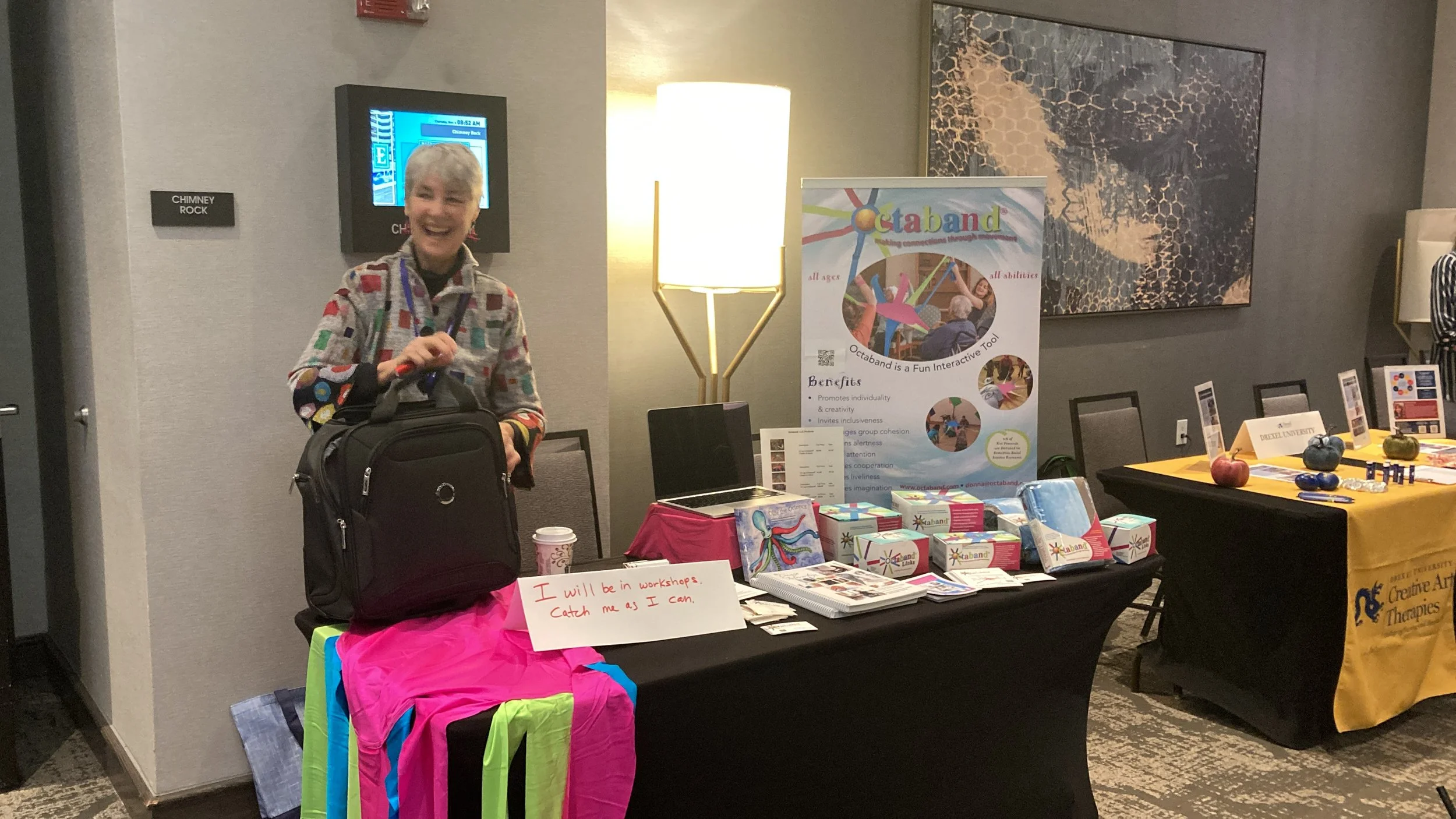
Photograph taken at Expose Dementia where I will be presenting and exhibiting again March 2026.

We live in a world of interconnectedness. That is what Dance for Connection and Octaband® are about. When we live by the understanding of this web of connections, we live healthier, happier lives. We strive for compassion to make the world better, not just for ourselves, but for one another. Not for some others, but all others. Because what affects one, affects us all.

Nature may not care one whit about what we believe, but it is affected by what we do. What the most powerful people in this current U.S. regime are doing is cruel, heartless, and entirely without conscience. What each of us does together can and must tip the scales of justice toward good.

So, while I protest, write postcards, contact legislators, donate toward just causes, and boycott corporations that support the regime, the most important thing I do is dance with people with dementia. Why? Because dancing with people with dementia keeps me humble, present, compassionate, and in love with life. It infuses my life and the world around me with positive energy, joy, and inspiration.

The trainings I lead are characterized by the extraordinary love and compassion of the trainees drawn to dance with people with dementia. Through experiential exercises, dance, discussion, and two groups dancing with people with dementia, we explore the facets of dance and dementia that make all of our worlds better. And in the process, we improve our brain and body health.

Don't wait. Register today to learn how to bring dance to people with dementia. The training is designed to meet participants where they are along the journey, whether entirely inexperienced but interested or with years of practice. Some trainees have taken the training multiple times because we learn through the lens of our embodied selves which are continually changing.

Together, we will infuse the world with positive energy, joy, and inspiration.

HIGHLIGHTS OF 2025 and LOOKING FORWARD

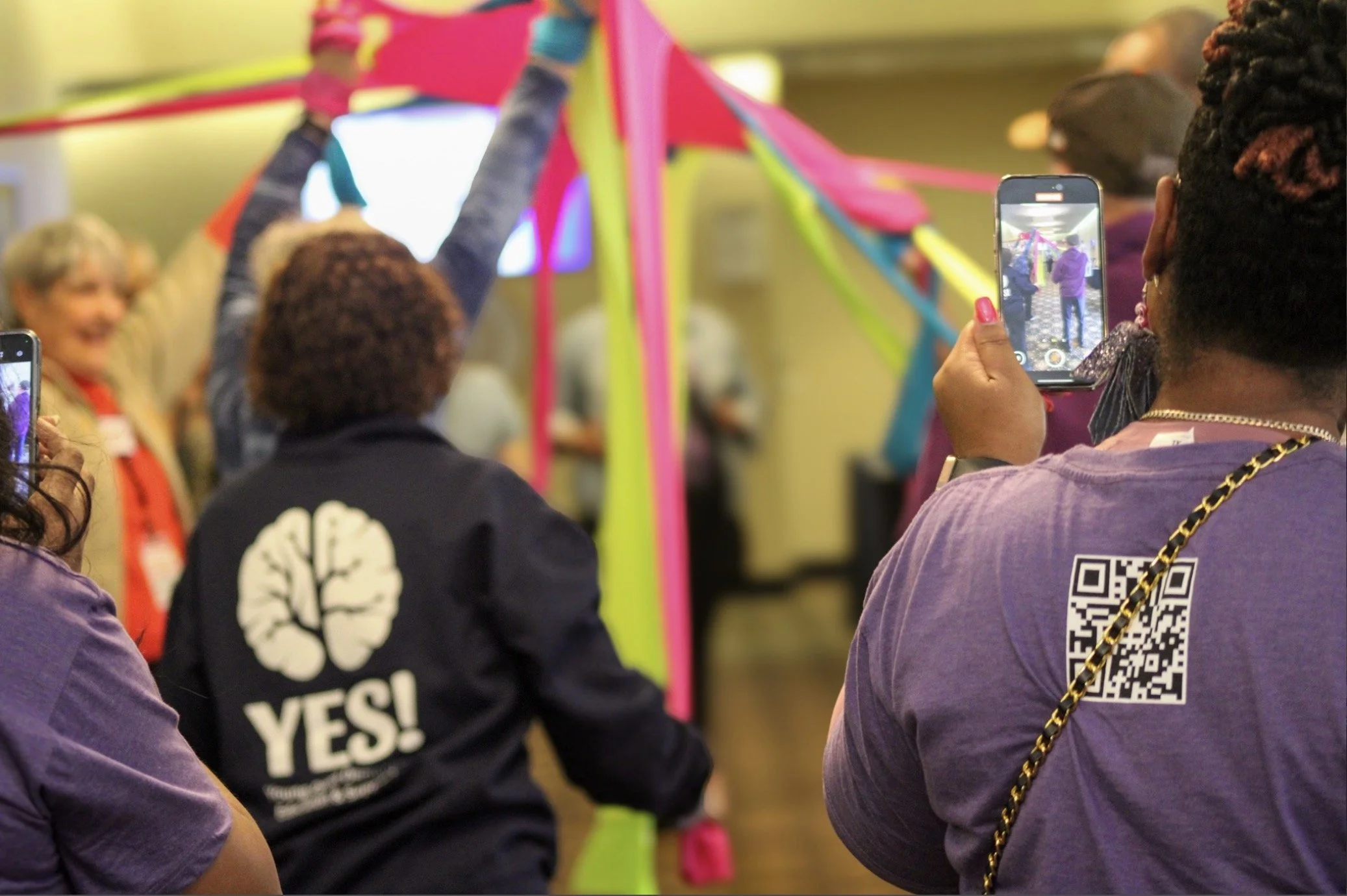
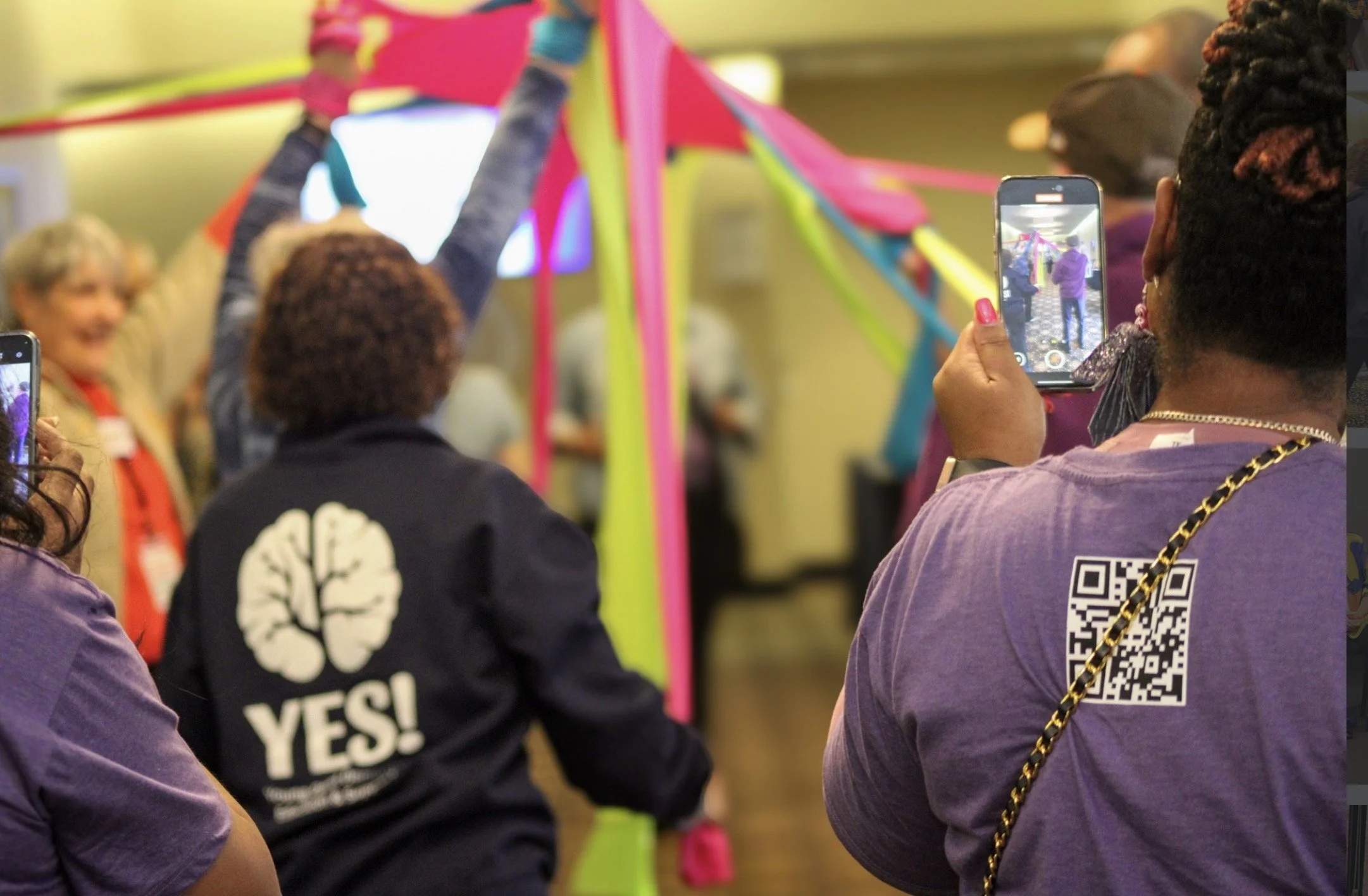
Demonstrating the Octaband® at last year’s Expose Dementia conference. Notice people photographing, videotaping! The Octaband invigorates caregivers.

2025 highlights include first and foremost exhibiting and contributing to the Expose Dementia conference whose mission is to raise awareness for dementia, especially in the African American community, and to reduce stigma and improve lives through art and advocacy. Their mission fits together seamlessly with mine. But what made this conference so hugely unforgettable was the love, generosity, and spirituality of C. Nathaniel Brown (Chuck) and the team that surrounded him. I am so looking forward to returning this year, March 19-21, 2026 at the Maritime Conference Center in Linthicum, Maryland. When we bring our love and create the opportunity for people with dementia to express themselves through art, we are changing lives and making the world a better place. I highly recommend this conference for the information imparted about dementia and how the arts, sensitively provided, meet the needs of people living with dementia. Learn more.

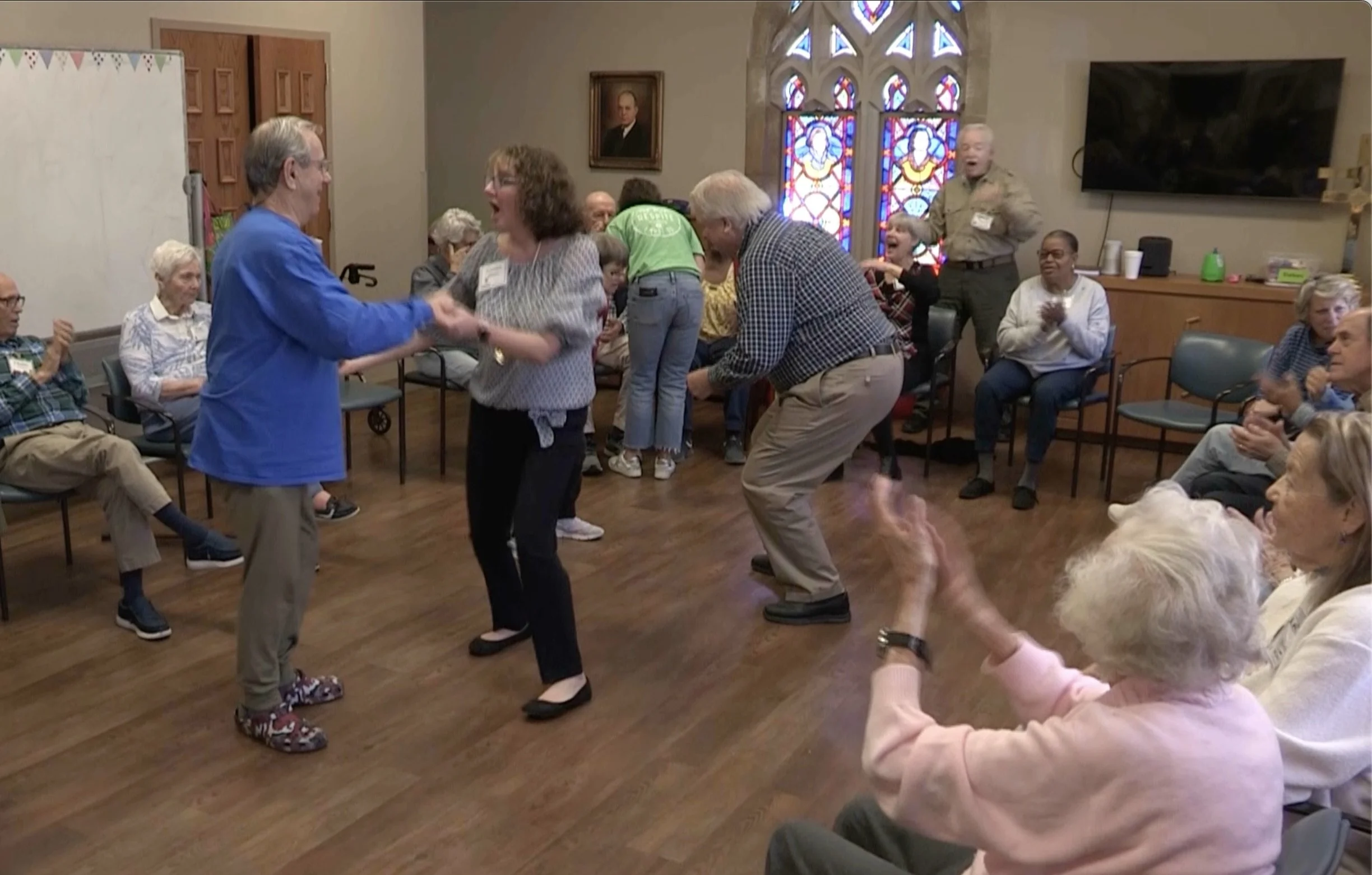
Many thanks to Respite for All (RFA) for the opportunity to facilitate a dance program with your community.

The many groups I facilitate always bring me great joy, and this year was no different. The more I consider what I can do to make the dance sessions more effective at increasing engagement and connection, the better they seem to get. I offer my deep gratitude to two wonderful women, Ines Costa Dias and Kathleen Anderson who have taken my Bring Dance training, and volunteered to help me at some of the groups. Also, to my dance/movement therapy friend and colleague, Dr. Heather Hill, for our bi-weekly zoom meetings where we work together on a book that we are in the process of writing. If you are considering taking a training with me, I have one scheduled this year, April 17 - 19, in person in Westwood, MA. The 15 hour training will include 2 groups with people with dementia. Learn more and register here.

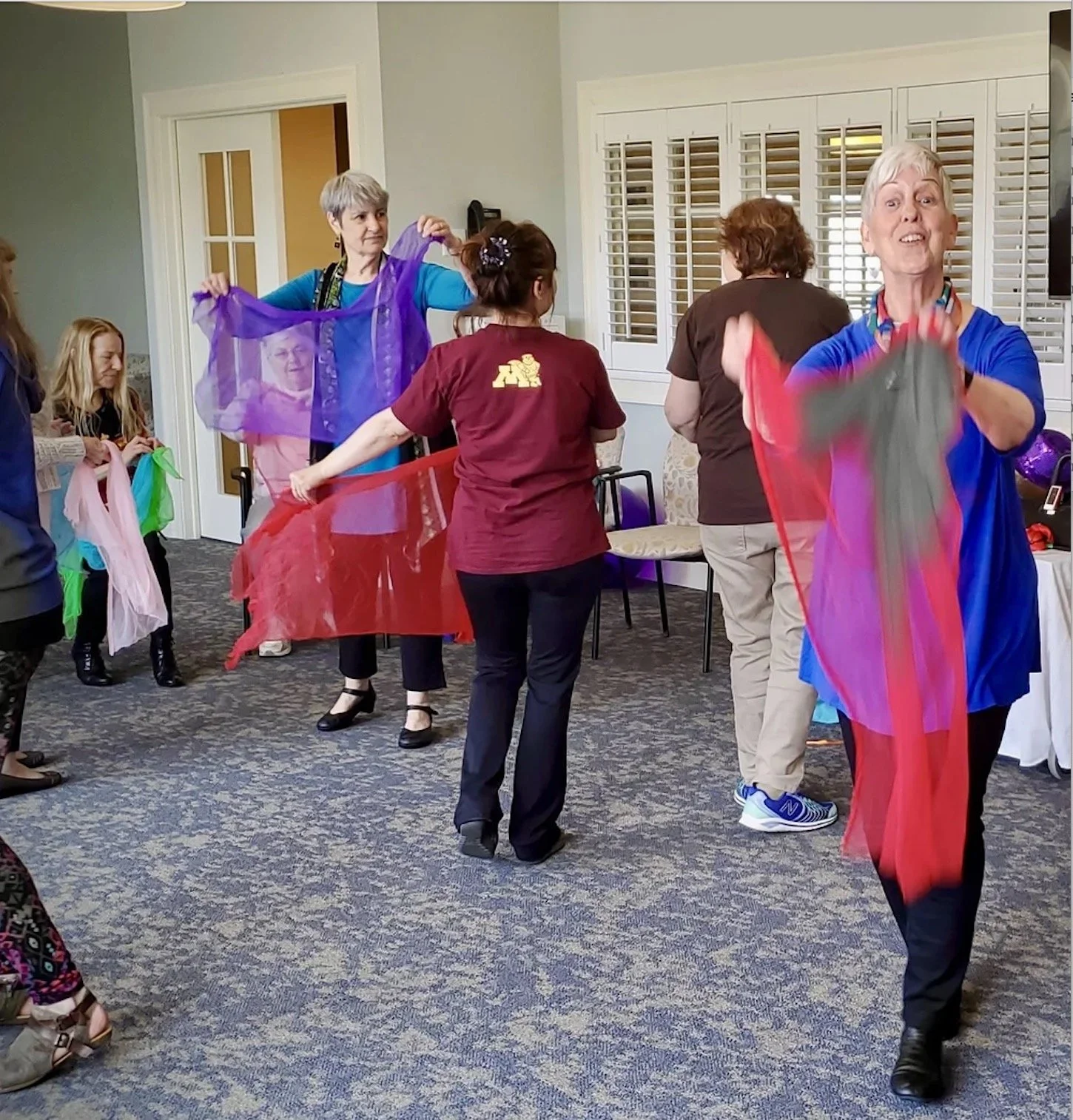
Image from a prior training held in Westwood.

This past year I was invited by Minh Bui Tuyet to teach a couple of virtual classes designed for Vietnamese students for BODY COMPASS Online Dance/Movement Therapy Introduction courses. It was a delight to communicate through movement (with Minh's translation) online with these students. I am hoping to collaborate again in 2026.

I was also invited to present a half day intensive, Embodied Connection in Dementia Care: Dance/ Movement Therapy at the Edge of Human Dignity, Advocacy, and Neuroscience, at the 2025 American Dance Therapy Association with my colleague, Dr. Cecilia Fontanesi. I am thrilled to announce that we have been invited once again to present on this topic, this time in greater depth in a full day intensive at next year's conference in Long Beach, November 5-8. Let this serve as a Save the Date.

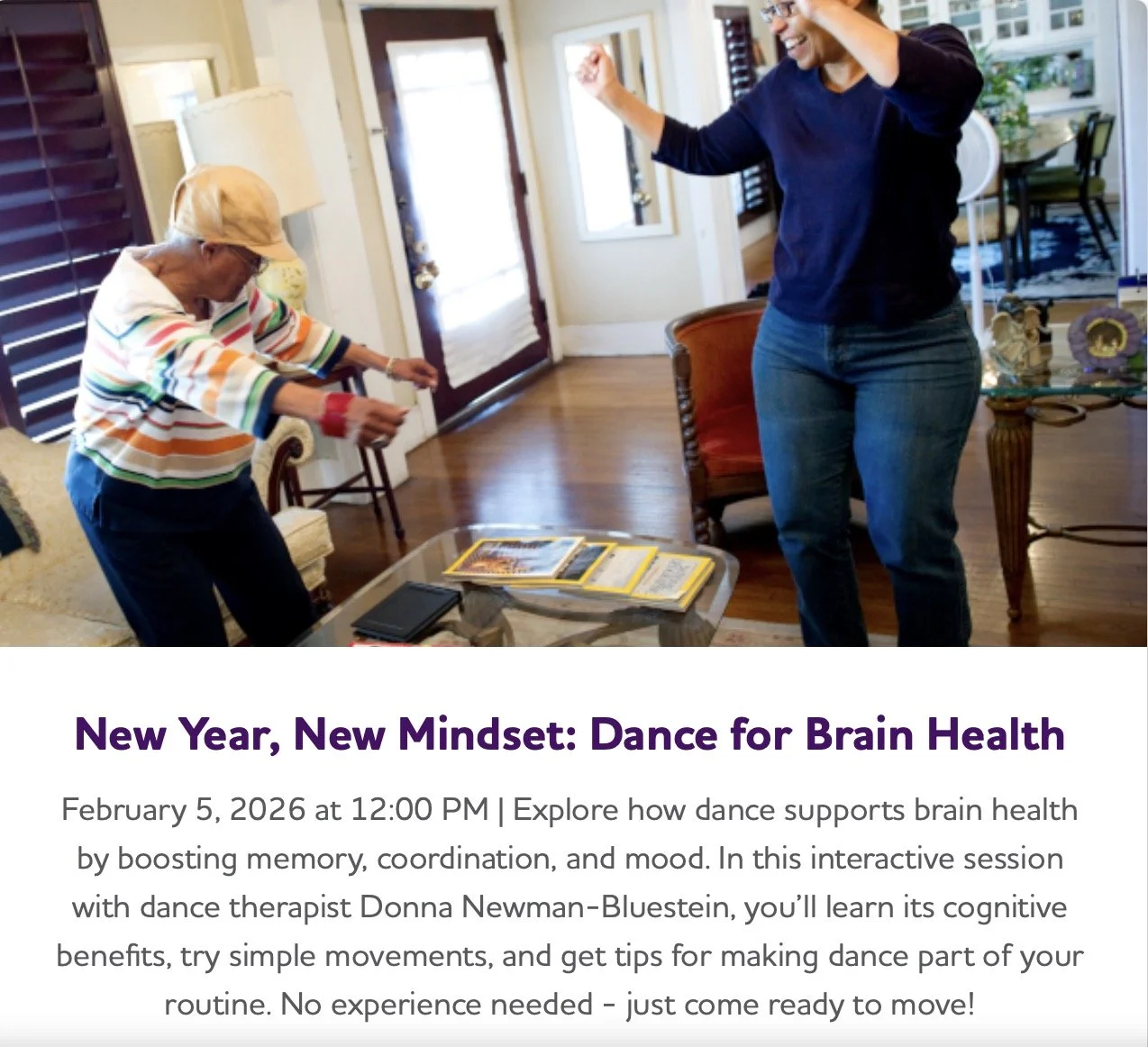
A couple of new things I will be doing in 2026. The Alzheimer's Association is offering a new series: New Year, New Mindset: Resolutions for Brain Health in 2026. On Feb. 5, 12 - 1 EST I'll be facilitating a 1 hour virtual program for which you can register for here.

On Feb. 27 I will be leading an in-person dance/expressive movement program at a Lunch & Learn for caregivers at the Sherborn COA. Learn more here.

Vitality, an Indicator of Meaningfulness and a Goal in Its Own Right

Last night I watched the inspiring Netflix interview of Jane Goodall, Famous Last Words, released posthumously as intended. It was a powerful story of one woman remaining true to her path from childhood, steadfast in her world view which informed her actions. A woman who dug down deep into her reality to care for the animals and the planet she loved.


In addition to reaffirming my intention to care better for Mother Earth, the film validates my following of my own path. After a career in dance/movement therapy which I have loved, whether it be working with people in acute psychiatric distress or in medical rehab, 20 years ago I discovered my true calling was in dancing with people living with dementia, providing dance from the perspective of dance/movement therapy.


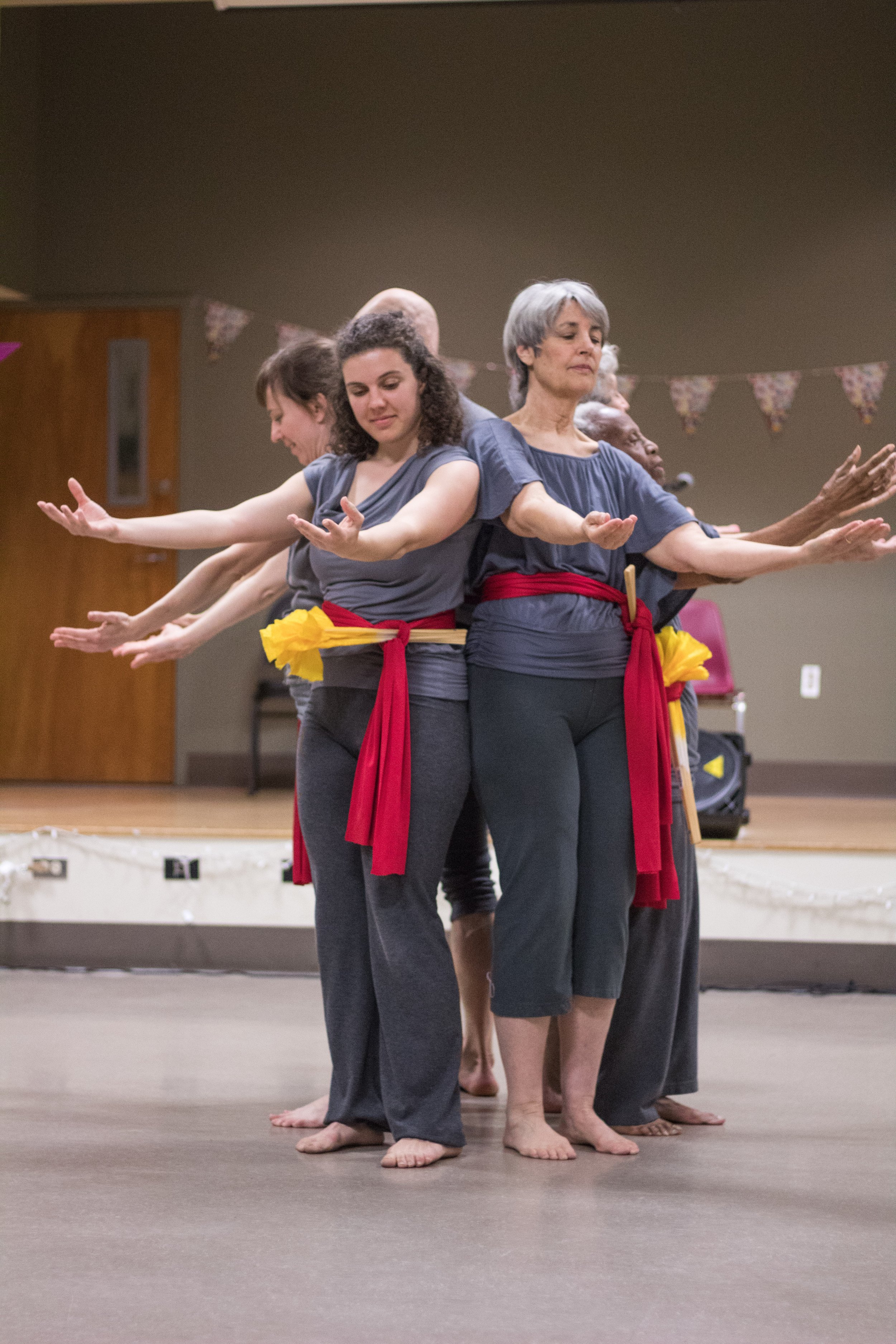
Now in my late 70s, I continue to be driven to understand all that I can about how and why dancing with older adults and people with dementia is so effective. Foundational is my ongoing involvement in the art of the dance, continuing to take classes and perform with intergenerational dance company, Back Pocket Dancers pictured above. On Friday, December 12, 10:30 - 12, we will have an open rehearsal at the Dance Complex in Cambridge, MA. All are welcome, although space is somewhat limited.

A Memory Café at Dedham Public Library which I helped get started.

Dancing with people with dementia, whether in Assisted Living residences or at Memory Cafés is joyously uplifting, energizing me and them and providing me with material to reflect upon to better understand the connections between dancing, increased vitality and aging/ dementia. To that end, Dr. Cecilia Fontanesi and I presented "Embodied Connection in Dementia Care: Dance/ Movement Therapy at the Edge of Human Dignity, Advocacy, and Neuroscience" at the recent American Dance Therapy Association conference. Cecilia and I discovered during the presentation that we are both highly motivated by syncopation. When the music and movement are only synchronous, we find it boring. Cecilia shared The Quality of Life Movement Assessment for Persons with Advanced Dementia, an assessment form which I created based on Laban Movement Analysis (LMA) and which intends to correlate movement observed with indicators of Quality of Life. You can download the assessment form for free here on this website. One of my findings in using this assessment tool is that vitality is both a measure of meaningfulness and a goal. When an experience is meaningful, people’s movement becomes more complex. I would venture a guess that more of the brain is lit up because of the many connections. I am grateful to Dr. Fontanesi, a dancer, dance/movement therapist, and neuroscientist for our continued work and explorations together.


My research is based on practice, my own lived experience, and that which I observe in the participants in my groups. I attempt to read extensively the research from related fields. My findings are hard even for me to believe. The more I consider what has worked, explore my hypotheses, teach, and write about them, the more joyous and meaningful the groups seem to be, based on participants’ responses and the number of business cards I am asked for following a group.


Oh - and by the way - if you've been wanting an Octaband®, now is a good time to purchase one. I've been holding out, trying to keep prices as stable as possible for as long as possible. Prices will go up in January 2026.


When we dance with older adults, "we invite them to be in their bodies, to savor the sensations and experience of vitality, now, in their last days, while they still have bodies." That, too, is what I ask for myself.

Happy Birthday, Octaband®

Photo credit: Priscilla Harmel, dance/movement therapist and photographer

Nineteen years ago today, I introduced the Octaband® to the world as I launched my first website where I offered 2 sizes of the Octaband for sale, the 8-leg and the 16-leg. Today, we offer yet a third size, the 24-leg, and, in addition to the classic colors of electric pink, turquoise, and lime, we offer an 8-leg and 16-leg in velvet spandex in more muted colors reminiscent of nature: a light blue, green, and brown. We also have Octaband Links which are resistance bands with loops on the ends for holding on to and which can be used individually or in pairs.

A Sense of Belonging

What was and is most important for me was for people to feel they belonged. As much as the field of dementia care talked about memory loss, I have found the most distressing issue facing people in aged care facilities is loneliness and isolation.


Octaband History

People often ask how I came to create the Octaband®. I believe there are multiple streams that come together to cause something new to come into being. Below are 2 layers of the story.

Octaband: A Solution to Isolation

I was working in a nursing home on a unit where people had physical and cognitive challenges and were behaviorally challenging. I was having difficulty engaging the 6 to 8 people in a shared focus or sense of cohesion. No one followed directions. Some slept, others shouted, or repeated themselves. I had to interact one to one to get anything to happen at all. That was when I remembered an image I was taught in graduate school - that there are times when the leader is the hub of the wheel and the interactions are the spokes. I wondered what would happen if I created a prop which manifested that image so that I could figuratively step out of the center and be on the periphery with the others. That was around 2003, when I created the first version, not even remotely like the one eventually offered for sale.


Dance for Connection History

But behind that version of the story lies a deeper layer. In 1993, I was one of 4 dance/movement therapists hired to provide services to frail elders as part of a research project funded by the NIH to investigate the effect of dance/movement therapy on mood, social interaction, and physical functioning of nursing home residents and adult day health clients. Music therapist Michele Forinash was inspired to provide a qualitative aspect of the research study to provide a better “understanding of essential elements of the [DMT] experience.” Based on the four therapists’ narratives - which included our clinical process notes, personal reactions, and general impressions - Forinash found, with all four therapists in agreement, the "Phenomenon of Connection"; that there was an essential continuum of connectedness, both internal and external underpinning all of our work. (Forinash, M. 1996. Facets of connectedness: A Phenomenology of dance/movement therapy with the frail elderly. Unpublished.)


Until that time, while I was operating under the assumption that I was using dance to help people feel a sense of connection, that idea was not yet entirely clear. Once I recognized my intention to build connection through dance, I found my groups all the more effective at achieving that goal. At the same time, and based on my ingrained understanding of the history of the Holocaust, I understood the importance of not just group-think, but also of being able to experience oneself as an individual.

Rachel Federman Morales at HMS School

Dance is such a powerful medium because it celebrates our commonalities. We all have bodies and move them to express ourselves and communicate with one another. Our bodies' ability to express ourselves is our lowest common denominator. At the same time, dance and the Octaband celebrate our uniqueness, our individuality.

Photo Credit: Werner Grundl

Dance for Connection and Octaband are importantly about acknowledging our mutuality, our interdependence. The different colors of the Octabands reflect our diversity. We, and the world, are better for our differences.

Preventing Burnout ~ What I've Learned in a Long Dance Therapy Career

Preventing Burnout ~ What I've Learned in a Long Dance Therapy Career

Somehow, I've managed to prevent burnout over the course of my decades long career. What's my secret? First of all, it's learning to listen to myself, taking myself seriously. When I begin to feel tired of what I'm doing or that I'm not continuing to grow and learn, I have left my position to find something more fulfilling. In doing that, I have worked with different populations and discovered what human beings have in common, despite their particular sufferings.

Another important thing is recognizing when I'm beginning to feel like a martyr. I think that many caregivers suffer from a martyr complex. We feel so good about giving to others that we can easily fall into a trap of feeling indispensable to that person or that job. When we do so, we deprive the other person of equal status and we burn out. We fail to recognize what we are getting out of what we're doing. And the truth is, it does feel good to give, but it is equally important to receive.

In the field of dementia care, I have found in Tom Kitwood's Dementia Reconsidered my bible. Take this quotation of Kitwood talking about Martin Buber: “His central assertion is that relationship is primary; to be a person is to be addressed as Thou. There is no implication here that there are two different kinds of objects in the world; Thous and Its. The difference lies in the manner of relating.

Kitwood goes on to say, p.11:

“One of the most famous of all Buber’s sayings is ‘All real living is meeting’ (193:11)…. In the meeting of which Buber speaks there is no ulterior purpose, no hidden agenda. The ideas to be associated with this are openness, tenderness, presence (present-ness), awareness. More than any of these, the word that captures the essence of such meeting is grace. Grace implies something not sought or bought, not earned or deserved. It is simply that life has mysteriously revealed itself in the manner of a gift.”

Kitwood continues so poetically. I could easily quote half of the book. I am grateful for all I learn from the many readings I do about dance/movement therapy and dementia, dance and dementia, and neuroscience, dance and dementia. I am also grateful for my network of friends and colleagues who also love dancing with people with dementia. And, importantly, I receive abundant gifts from the encounters I have with people living with dementia.

On June 15, you have the opportunity to learn my most current thoughts about dance and dementia in a webinar sponsored by HKDMTA, open to all for a modest fee - just under $40 for an individual webinar, full bundle: $256 USD.

👫 Bring a friend – both get 20% off ($31 USD)

👭 Bring two friends – everyone gets 25% off ($29 USD)

This session is ideal for therapists, caregivers, and healthcare professionals involved in dementia care.

Time Zones: 5:30 - 7 AM EST, 8:30–10:00 AM PT, 1:30 - 3:00 PM BST, 2:30–4:00 PM CEST.

Register now.

Why a Better Understanding of Nonverbal Communication Is So Important for Care Providers

Western cultures that hold the cognitive mind in greater esteem than the body, emotions, and spirit create inhospitable environments for people with declining cognitive abilities. Challenged to live in a world which undervalues their abilities can be isolating and humiliating for a person living with dementia.

Yet, even as their rational “thinking” abilities decline, people with dementia often become more attuned and sensitive to their social and emotional environments. They are often expert at reading emotions and nonverbal communication because their emotional safety depends on it. Expert.

Every person comes into the world without words. We learn to communicate, relate to one another, and begin to develop mastery over our worlds before we have verbal language. As carers, we need to tap into that way of knowing again, for that understanding is what people with dementia retain the longest. Without words, they must rely once again on nonverbal communication because the meeting of their needs and their emotional safety depends on it. So how do we as care providers help people living with a dementia experience emotional safety?

About 20 years ago, I approached the Director of Education and Training for an Alzheimer’s organization. I was offering my nonverbal communication training to his agency. I told him that, at the time, the U.S. was not focusing on the social emotional environment for people with dementia. I saw it evident in the literature in the UK, Canada, Australia, and Sweden, but not the U.S. I had recently completed a 20 hour training, of which 1 to 2 hours in total were spent on communication, and, of that, only 15 or 20 minutes was on nonverbal communication. I said, “but that’s the language people with dementia speak.” He answered “they” (the powers that be) want professional trainings in “behavior management”. Therein lies the problem. As soon as we see '“behavior management”, we see a problem to be solved rather than a person who’s suffering, having difficulty communicating their needs. I replied, “They want easy answers”; they want a problem fixed.

It’s as though we learn 12 words in another person’s language, and think that’s sufficient. We give people10 rules to guide them. What we need is the ability to connect the dots, to feel the feelings in the space between us. Not a small thing. We need to learn their dialect. How to be. What a glorious lesson we have the opportunity to learn.

You can watch me speak on this topic in an ADTA Talk, sponsored by the Marian Chace Foundation of the ADTA: https://youtube.com/shorts/XKNaIkx4tOU?si=2HoEhOPXb6RXvgji

You can purchase the manual here. Or an Octaband®, which can help you focus on the space between.

Washing away the barriers that separate

When we sleep

it's our unconscious helps us integrate,

not our conscious mind

grasping at concepts to

protect us from fear and sadness

and the mortality of being someone else's food.

We must merely step into the stream,

allowing tears of loneliness to

wash away the barriers that separate us.

If it's the quality of our attention and listening that

helps us bridge the gap,

that quality is one of seamlessness.

There is no separation

between your pain and mine,

between my love and yours.

It is in the safety of your care full love

that I overcome my fears

to step into the everlasting beauty

that is my particularity

in this tragedy/ comedy

we call the improvisation of life.

To honor our mothers and fathers,

our ancestors, is my path.

and as we are all one,

I honor all those who have

come before us

In homage to their love.


The poem above is one I wrote on woking the last morning of the 2016 Memory Bridge retreat. I am struck by its relevance to my experience this past weekend of my spiritual community’s retreat. In the safety of this loving community to which I have belonged for 34 years, I, and we, reveled, learned, laughed, flourished, and healed one another.

In leading the closing circle for the retreat, I found myself awash in the stream, seamlessly allowing the teachings to flow through my words and movements. I listened as attentively as I have ever listened, appreciating the offerings of every person. I was succinct in my contributions, astonished that what I left out, others filled in.

In truth, we are one.

Wholly and Holy

Each time I prepare to lead a training to Bring Dance to Older Adults and People with Dementia, I consider what is the most important thing I would like people to leave with. I always want to teach my latest realizations and thoughts and am also faced with the challenge, not only of what I consider the priorities, but also in what order they will be most effective. Of course, I plan to teach the most important things, but the order will depend upon the participants' needs, just as they do in a DMT group with people with dementia.

The most important thing

Fifty years ago, I had a seminal experience in a continuing education class with Dr. Buryl Payne, American psychologist and physicist. In that class, I saw on biofeedback equipment, a person's brainwaves altered dependent upon whether or not people were holding hands in a circle. That led me to understand that, at least if we were holding hands, even if we were not beside the person, we were affecting others in the group. I extrapolated - rightly or wrongly - that even if we are not holding hands, we are always affecting one another. That has become the basic premise upon which I have led my groups since I began working as a DMT. Based on the results, as evidenced by my senses, that hypothesis appears to be true. Thus the following quotation in a recording of an interview of Michael Verde of Memory Bridge on "Empathy: 'to climb into someone's skin and walk around in it'. 


"Imagine someone who has the confidence that who they are does not have to do with being above people; that, there's a sense in which their membership is never going to be terminated. When a person like that interacts with a person with dementia, they are able to notice things that they would not have noticed if they came in full of anxiety about their own identities. With the kind of confidence they have from themselves participating in community, they can then interact with people with dementia in such a way that the common elements in dementia start to come into their awareness."

It is such a cohort where people feel accepted without judgment in a space that we co-create, that I attempt to nurture in my trainings. That is the most important thing. If we are to provide a container where people with dementia are to feel a sense of belonging, we need to bring that confidence in our own belonging first.


Michael Verde says much, much more in that interview that I found valuable enough to have listened to twice. To entice you to listen for yourself, here is another quotation without the larger context. Michael is asked: "How do you know that spending time with people with dementia matters? How do you know that love matters?" He responds,

"My question is, I will be happy to try to bring forth evidence that love matters, if you would meet me halfway and bring forth evidence that anything at all without love matters. . . What we mean by evidence might have everything to do with whether or not we're looking through our own eyes or the eyes of something that transcends our own ego. And having someone to tell it to must be an absolute vital step in being able to let go of our caste system membership and to step into a place where we're folks and we can talk about ourselves in ways without fear of being ostracized and come to know who we are, perhaps for the very first time."

I wish I had the confidence to answer in such a way when people ask for analytical research about how I know that dancing with people with dementia matters.


I titled this issue "Wholly and Holy" because this sense of belonging I spoke about seems to me to be about knowing our place in the universe. When we feel fully, or wholly, accepted for who we are rather than what we do, our place among the people, the animals, and the plant life, at the very least we can feel a sense of ease, we can be more effective, and perhaps, on occasion, have a transcendent / spiritual / holy experience. And, lest you think I've got that one covered, as I often say, "We teach what we need to learn."

You can learn more about what I know by scheduling a training with me for your group or purchasing the manual that I co-authored with Dr. Meg Chang, The Dance of Interaction. Please note that the price of the manual is now $34.95 as publishing prices have gone up.

#personcenteredcare, #dancetherapy, #dancemovementtherapy, #danceanddementia, #danceforconnection, #thedanceofinteraction, #nonverbalcommunication

Using the Octaband® in a Maypole Dance

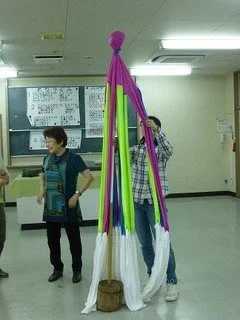
The Octaband is a wonderful prop to use as a Maypole, celebrating Mayday.

In the first video below, Laura DeCesare is teaching an intergenerational group how to do the Maypole dance. We were not as quick to pick it up as her preschool children, but we had fun. https://www.youtube.com/watch?v=Bcifwms9daQ


Following is a series of photos of a group led by a Japanese music therapist with the Octaband as they did a Maypole dance. The images were provided to me by music therapist friend and colleague Juni Endo, whom I have unfortunately lost touch with since the Pandemic.


Next is an image of a child in the center with the Octaband resting on her head. You could have the tallest person play this role.

Photo credit: Charles Daniels

Finally is an image of the center of the Octaband with flowers in the middle in a group with people with dementia, led by dance/movement therapist Whitney Lee Peruzzi.

At a Memory Café in Westwood, MA, I placed flowers on the center of the Octaband as Whitney had. I played several songs, first Sweet Violets by Dinah Shore, to which we gently bounced the flowers on the center. Then to Tip Toe through the Tulips by The McGuire Sisters, we continued bouncing the flowers, while moving our feet as though on tiptoes. Finally, to Where Have All the Flowers Gone by The Kingston Trio, began shaking the flowers off, at first just a few and then riotously.

The Octaband and a little imagination go a long way to helping people forget their troubles and join together in joy.

#Octaband #DanceTherapy #Dancemovementtherapy #MaypoleDance #ExpressiveTherapy

Context Is Vital When Engaging with Someone with Dementia

In fact, context matters ALL of the time, and for all of us.


When a person with dementia says something that doesn't make sense to us, how do we make sense of that person's statement? Do we see that as a symptom of dementia? Do we seek to understand its meaning for that person.

This was the theme of last week's Memory Bridge TCL (The Caregiver's Library) webinar Our Body Lives for Meaning.

In the webinar, Michael Verde provides the listener with a concrete scenario to consider: A man in a care home suddenly becomes alert and says: "Is the truck coming? The truck is coming - I've got to get ready." Michael asks the listener, "How do you imagine what's going on in his mind?” “What is going on in your mind?" He suggests that what is happening in our imaginations affects what happens within the person with dementia.

So, I asked myself, "What's going on in my mind?"

I observe that the man begins with a question, followed quickly by a statement which leads to an assessment of a need for action. The quickness is how I imagine the scenario plays out.  I imagine that this man is experiencing a sense of urgency for some reason. I want to know why. I'm curious. I want to know what is happening in his mind. I experience his urgency as an expression of some anxiety that may be founded in a past experience. I want to ease his anxiety if my perception is accurate. I attempt to ease the anxiety I feel by joining him. This is how I understand co-regulation.

In the webinar, Michael suggested that we allow what could be labeled a 'behavior' to be an opportunity for a meeting - a relationship. We are companions in the same world.

In The Dance of Interaction: Embodied Relationships in Dementia Care, in a chapter entitled "Relationship-Centered Care", I offer the following:

“Relationship centered care, as the name suggests, is care that puts the relationship between people at the forefront. Care that centers on the emotional connection encourages a strength-based mutuality that considers what is possible rather than the deficits of a person living with dementia. In such a relationship, the quality of a person’s daily life becomes more important than the schedule to be met. Rather than care that is centered on completing a task such as getting dressed, or is directed to managing a symptom such as agitation, often referred to as a behavior in the medical model, care that puts the relationship first sees each person living with dementia as a human being who has something to contribute and who benefits from caring interaction. Rather than ignoring an individual’s request because of disorientation, the caregiver strives to satisfy the person’s needs and wishes. Therefore, relationship centered care is based on capabilities and interests — what the individual can and wants to do, and is holistic — it considers the whole person.”

“Every interaction with a person with dementia is an opportunity to build a relationship.”

If you are interested in deepening your capacity for empathy, I highly recommend Memory Bridge's TCL webinars.

Dr. Heather Hill, Australian dance/movement therapist and internationally renowned expert in dementia care wrote, "The revolution of this manual is that it brings to attention the embodied, relational nature of care and offers some stepping stones towards changing the way we train for care.” You can purchase The Dance of Interaction here.

The Importance of Imagery in Creating Collective Joy

About 32 years ago I was at a bat mitzvah. The DJ was playing such great music, no one could stay in their seats. It was then I began thinking that in some ways, that is what I do as a dance/movement therapist with people with dementia.


At the nursing home where I worked, I saw a few minutes of a DJ who came to perform for the residents. He was playing the Macarena. He had staff perform it in the middle, facing the residents and doing the Macarena. The residents were clapping and enjoying it, but they weren't dancing. I asked him to play it again, but this time, get the residents engaged. He repeated the instructions he had given the first time - nothing changed. I realized he didn't know how to adapt his cues so the residents could join in. So I approached the recreation department head who had hired him and asked if I could facilitate the session the following month. I got the okay.


That was the beginning of Dance Thursdays, a fabulously successful monthly gig where I began leading groups for as many as 75 residents. I encouraged aides to bring people in geri chairs as well as people who could stand up and dance. When I led the Macarena, I asked them to keep touching some part of their body, and now shake. It was such a joyous affair that family members would come so they could see their loved ones having such a good time.


DJ Dancin' Donna is one of the images I hold when l bring dance to older adults and people with dementia, a persona, if you will. Finding one's personal images is one of the topics I teach when I train people to bring dance to older adults and people with dementia. Topics range from the theoretical to the practical. All you need to bring is a love of dance and a desire to dance with this population.


Consciously Building Community for People with Dementia

What does that mean? In the  late 1980s, Tom Kitwood began talking about person-centered dementia care, drawing on Carl Rogers' idea that each person has the capacity and desire for personal growth and change. I think of it as, given the right nutrients, people grow, just as grass grows. Eventually, the concept in dementia care expanded to relationship-centered care. I have broadened that concept yet again with the idea of 'creating the village' together. Many of us don't live in such a community, but certainly the continuum of care communities that are opening up all around the country speak to the need for these communities for older adults. But how do we create such a community for people living with dementia who may not understand that concept?

I create a conscious community every time I meet with people with dementia - through intention, ritual, and dance. Intention informs everything that follows. Ritual sets the time and space apart as special - sacred, if you will. Dance builds on nonverbal communication, so that even if people can not understand words, they can understand nonverbal communication. After all, that is our first language - for every single one of us. That allows us to begin our time together operating from the basic common denominator, a way of interacting that most everyone understands.

I attempt to create that conscious community in every training that I lead as well. I am working from another basic common denominator, that we all need to understand what it means to belong from the inside.

I highly recommend Memory Bridge, which offers biweekly webinars expanding upon these concepts. https://www.memorybridge.org/shop/ . Today's topic is Belonging: The Science of Creating Connection and Bridging Divides, by Geoffrey L. Cohen

I am extending the Earlybird Deadline for the June 1 and 2 Bringing Dance to People with Dementia training in Dedham, MA to May 22. If past trainings are any indication, it should be extraordinary. Building conscious community together and bringing it to people with dementia in dance groups is pretty mind-blowing.

Learn how to bring excellence to older adults and people with dementia, including those who are nonverbal. June 1 and 2 in Dedham, MA. Find out more here. 

You can click here to register.

Nothing Short of Excellence is Good Enough Care for Older Adults in Residences

In 1974, I saw Judith Jamison perform Cry with the Alvin Ailey American Dance Theater. Her performance so moved me that I went back to see her twice more that week. It was after the 3rd performance that I had a dream which ultimately led to my becoming a dance/movement therapist. Because dance informs my work as a dance/movement therapist, I continue to dance, attend dance performances, and perform with Back Pocket Dance Company.

Fifty years later, 2 nights ago, I went to see the fabulous Alvin Ailey American Dance Theater perform again. After a night of many colorful dreams, I awoke thinking, "It's good to see fabulous dance. It wants to wake me out of my relative stupor and live life more vibrantly. Terpsichore, the muse of dance and poetry inspires - breathes into me - excellence.

It is that excellence that our older adults, especially those who are dependent upon others, deserve and which is so sadly lacking in most, if not all, residences for older adults. While others tell me about facilities that they consider good, I think that is a relative assessment - better than others. To me, good means that every person gets individual attention.

Here is what I saw recently in long term care described as good when I was visiting during a sing-along with an outside entertainer. Some people were singing along, and the entertainer gave encouragement to the group. Others were staring at the wall. I heard "Sit down" repeatedly to a woman who was entirely capable of walking, but she wanted to get up during a program. Not allowed. CNAs sitting at the back of the space where the entertainment was, writing their notes. At a prescribed time, people were offered popcorn on small styrofoam plates. Zero individual attention. By the entertainer or by the CNA's. No one was looking at them, so didn't see when the popcorn hit the floor, nor when people bent over (good reaching though)  picking up the popcorn and putting it in their mouths. They didn't see the man tear his styrofoam plate up into small pieces and put it in his mouth. Chewed on it, but it wasn't quite satisfying. Because there isn't much difference between popcorn and styrofoam, is there? I saw people beaten by the tedium of the system.

People living with dementia, particularly those living in institutions (I could call them residences, but let's call them what they are) may be the greatest beneficiaries of dance. Told to sit down, likely because staff are afraid they'll lose their balance and fall down. Those folks are among the most inert - not because they can't move, but because they can't initiate and no one wants them moving. That's when trouble occurs. Nursing homes and elder facilities are graded on how many falls there are. So how do they deal with that? Put folks in geri chairs. You try getting out of them when your core muscles are atrophied.

Below is a poem written collaboratively by Dorothy Shea and myself some years ago. Dorothy had suffered from a stroke. Writing poetry together was the only way I could motivate Dorothy to get out of bed or to move at all. The words and images were all hers. I helped rearrange them somewhat. She gave me permission to publish her poetry. "The Last Station" was her response to having an alarm which went off when she attempted to get out of bed.

The Last Station

Written collaboratively by Dorothy Shea and Donna Newman-Bluestein

The depths are getting to me;

depression, dying, the sound of dying, not being.

It can be quite loud if it wants to be,

Heaven only knows what it wants to be.

Depression is the last stop of life.

Nothingness.

A place where you can’t get off,

a train station full of cinders.

No light, no color, no sound, no texture.

Nothingness.

Behind us is light, life;

Ahead of us, nothingness,

A melancholy scene.

I am so pursued by loss and death.

Why should I be pursued?

Surrounded by lovely gadgets that go off,

making ghastly noises.

A terrible engulfment greets me when I open my eyes,

being received in the depths of hell.

5 stages of death lie waiting for me in the morning,

and I’m held back by them.

Maybe this time it’ll get me.

I never thought I’d abhor death,

but now I do.

I’d like to be rid of this horror,

have the gadgets stop haunting me.

They have to push ‘em, poke ‘em, and punch ‘em

to get ‘em to stop screaming.

There’s terror in merely recounting.

I can’t run,

tagged by hideous squawking sounds,

making it all the worse.

“Look out. You may fall.”

I would trade poetry for life now.

I remember when n.h were smelly places, with diapers in hallways. Yes, we've come a long way. But do not accept that as good enough. This is not honoring our mothers and fathers.

What I want to see is what I offer. Individual attention to every person in my groups. Yes, it is a lot of work. But they deserve it. That's why I need the inspiration mentioned above. It's how I nurture and energize myself so that I can help animate people who need it.

This quotation by Ailey expresses my belief that, "Dance is for everybody. I believe that the dance came from the people and that it should always be delivered back to the people," And this from Pearl Primus: Dance reaches "that which we are without the veneer and sophistication and without all the language."

Learn how to bring excellence to older adults and people with dementia, including those who are nonverbal. June 1 and 2 in Dedham, MA. Find out more here.

You can click here to register.

What Is a Dance for Connection?

Dancing at the Dedham Public Library

Dance for connection emerged as a concept for me in 1993, when I was one of four dance/movement therapists employed to provide services to frail elders as part of a research project funded by the NIH to investigate the effect of dance/movement therapy (DMT) on mood, social interaction and physical functioning of nursing home residents and adult day health clients. The quantitative research was poorly designed, but I won't go into that here. However, music therapist Michele Forinash was inspired to provide a qualitative aspect of the research study to provide a better “understanding of essential elements of the [DMT] experience.” Based on the four therapists’ narratives which included clinicians’ clinical process notes, personal reactions, and general impressions, Forinash found, with all four therapists in agreement, the Phenomenon of Connection; that is, an essential continuum of connectedness, both internal and external underpinning all of our work. (Forinash, M. 1996. Facets of connectedness: A Phenomenology of dance/movement therapy with the frail elderly. Unpublished.)

When the intention is to build connection, dance, is powerful because it celebrates our commonalities. We all have bodies and can move them to express ourselves and communicate with one another. Our bodies' ability to express ourselves is a lowest common denominator.

Today is International Dance Day: "This day is a celebration day for those who can see the value and importance of the art form “dance”, and acts as a wake-up-call for governments, politicians and institutions which have not yet recognised its value to the people and to the individual and have not yet realised its potential for economic growth." Sidi Larbi Cherkaoui, dancer and choreographer, offered this message for International Dance Day 2012 “People reflect each other constantly, but when they dance, perhaps what they reflect most is that moment of honesty.”

It’s about connection that is real and honest and in-the-moment. It's about connection internally and externally, so that we truly feel a sense of belonging. That is why my business is called Dance for Connection, to self, others, and the world around.

Only when a person truly feels they belong will they offer their unique gifts. Only then will we minimize human suffering and maximize human potential. “[A]s a society, . . . we have everything to gain and everything to lose, in how well or how poorly we manage our need for human connection.” (Kirkus Reviews. Cacioppo, J.T. & Patrick, W. (2008). loneliness. Back cover.)

So let's enjoy dancing on this International Dance Day. If you need a bit of inspiration, I've loved watching this video by Nederlands Dans Theater repeatedly.

If you want to learn how to bring a greater sense of connection through dance to people living with dementia, find out more here.

Click here to register to learn to bring dance to people with dementia.

Donna Newman-Bluestein

Learn to Bring Dance to People with Dementia

My life's work as a dance/movement therapist has been about "seeing" what is invisible to the eye. The Octaband®, which I created, makes visible the space between us ~ the heart space. It is enormously powerful as people see their connection to one another -- especially people with dementia who live in residences and so often feel isolated and abandoned, and even more so those who are no longer verbal. The fact that they can't speak does not mean that they don't know what's going on around them. They flourish when they feel connected.

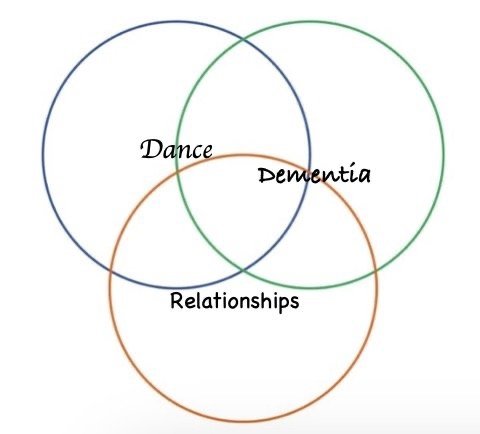
My trainings to bring dance to people with dementia teach us how to see and understand the space between people through the interface of three topics: dance, dementia, and relationships.

Perhaps you wonder why you might want to take my upcoming training, June 1 and 2 in Dedham, MA.

With all due humility, 45 years of experience has given me a lot of opportunities for trial and error. I believe I have found ingredients that make for a successful group, whether I lead it or someone else does.

Sometimes observers say that it's just the music I play that makes it so good. I'm thoughtful about the music I play. I spend time customizing playlists, tailored for participants' ages, social and cultural backgrounds. There are over 2,000 songs on my playlists. Other people say it's just the Octaband®. No, it's actually not, but I did happen to create the Octaband because I saw the need and a solution. The need? People living with dementia, especially those who have lost words, need to feel connected. That is so important for people who often feel isolated, neglected, irrelevant. Without each person, the group would not be the same. Every person contributes a bit of who they are.

In the training, we learn to see their contributions in small shifts in their engagement, which we can note and amplify so people move more and feel more alive. While a lot of training about dementia focuses on the brain, in this training, the focus is on personhood, building on people's abilities, and how we can use dance in the context of our relationship to minimize the effects of dementia. The results are extraordinary.

Tammy Center, Director of Respite Ministry, Montgomery, AL, said the dance group I led for her folks 2 months ago 'was a smashing success'" "What an AMAZING demonstration. We loved it so much." "The energy and excitement was incredible and we are and will definitely be moving more." And then, she wrote to say, "You would be so proud of our day today." That certainly makes my heart glad.

Shayndel Kahn, pictured above, took my Bring Dance training and recently shared some photos. "I just led a wonderful group this morning at an assisted living. There was a 100 year old and 110 year old! They all loved it. I loved it. I am also leading groups at another facility monthly. Thank you so much for being my teacher in this.

Yet another recent trainee reported a day after a training, "I used some of the new tools that I learned from you with my dementia client today - and I was totally blown away how they worked!!!!! . . . it all went so smoothly and well, I still can't believe it! And what almost made me cry was that in the middle of dancing she says to me "You are a really good person, you keep putting up with me even though I'm so difficult"!!!! I was so touched . . . And I remembered why I do this work. So THANK YOU for EVERYTHING - it was already more than worth it!"

Click here to learn more.

Early bird registration ends May 15. Register now.

Is There Life after a Dementia Diagnosis? Might We Savor a Long Slow Dance?

Savor is one of my favorite words these days. Like a good dark chocolate sitting on my tongue, or soaking in the limited glimpses of the sun lately, I like to savor experience. Dance, especially, because it allows us to perceive the world 3-dimensionally.


As an older adult myself, I know how important dance is for my health and well-being. It's not just exercise, it's dancing, sometimes to music, and mostly in community. I am fortunate to live in a part of the world where dance is accessible to older dancers, whether improvisation, modern dance, or dancing stories. The sense of community that we have, the appreciation for one another and our lived experience is palpable in every one of those groups. My teachers have to practice firm leadership to keep us from dissolving into socializing. Dancing in community is such an amazing antidote to the suffering many people experience from loneliness and isolation. As dancer Elaine Shann said after an evening social gathering, "It was a night to remember and cherish forever. In this ever disappointing world we have found a refuge. In Art,  Fellowship and Humor. Aren’t we the lucky ones?"


We've all heard the story. Alzheimer's, the long goodbye. I have spoken with many people diagnosed with dementia who say that when they received their diagnosis, their doctors provided no resources - just told them to go home and put their affairs in order. What an insensitive, indifferent, and unhelpful treatment of a fellow human being in their care!


The long goodbye. As we age, we all ought to be preparing for this. As Morrie says in Mitch Albom's Tuesdays with Morrie, "Everyone knows they’re going to die, but nobody believes it. If we did, we would do things differently. . . . There’s a better approach. To know you’re going to die, and to be prepared for it at anytime. . . That way you can actually be more involved in your life while you’re living." Morrie suggests, "Do what the Buddhists do. Every day, have a little bird on your shoulder that asks, ‘Is today the day? Am I ready? . . .  Am I being the person I want to be? Morrie, who had Lou Gehrig's disease said, "Not everyone gets the time I’m getting. Not everyone is as lucky.” Lucky! Imagine saying that when you can no longer take care of even your personal care any longer.


When I think about the little I know, or imagine, about death, it is that our flesh-and-bone bodies are no longer part of us. As we shed our physical aspects, our hearts, minds and spirits may continue on. Seems to me now is the time to truly relish our physical selves.


And so, for people living with dementia whose cognitive abilities are diminishing, don't you think it would be a huge benefit to attend to those parts of them that are still functioning and can, in fact, continue to grow?

A rainy day dance at the Dedham Public Library’s monthly Memory Café


This is what life can look like for someone with dementia who is offered the opportunity to dance. How sweet for this couple to be able to be together in meaningful ways where they can continue to be in mutual, loving relationship. (She asked me to take the photo for the local newspaper.)


It seems wise to savor our bodies as we dance and move expressively in our later years, while we still have bodies.


I feel blessed to have found my calling 20 years ago. My calling is not only creating opportunities to dance with people with dementia, but teaching and providing others with the support to do the same. Check out my next training in the Boston area, June 1 and 2. https://danceforconnection.com/upcoming-events/2023/9/4/bringing-dance-to-older-adults-and-people-with-dementia-virtual-training-el89n-f7ksx


This is the link to register: To register: https://danceforconnection.com/store/bringing-dance-to-older-adults-and-people-with-dementia-virtual-training-gl4ey

by Donna Newman-Bluestein