
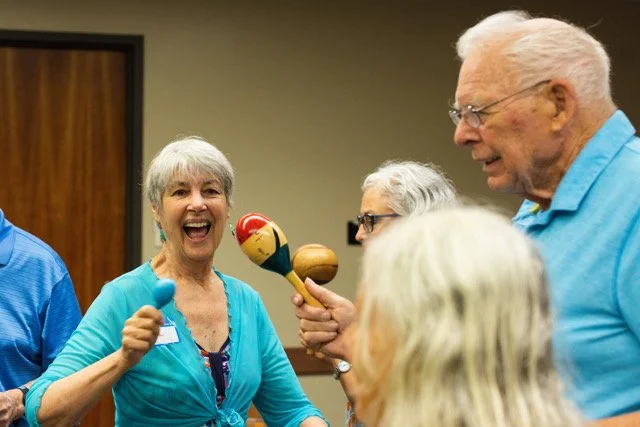
Facilitating a group for the Needham Memory Café where I will be again tomorrow, October 27.
In 1984, I wrote an essay about the theoretical underpinnings of my work which was accepted for board certification as a dance/movement therapist by the American Dance Therapy Association (ADTA). In reading it 42 years later, I find my foundational beliefs remain much the same, even while I have continued to learn and grow as a practicing psychotherapist.
Trudi Schoop’s Won’t You Join the Dance? was and continues to be influential. Repeatedly, I return to Schoop when I’m stuck or when I need to remember good leadership qualities, including a sense of humor.
As a therapist, my underlying goal is to accompany a client in their journey toward health, or a sense of wholeness. To accomplish that goal, my first task is to create a safe environment where trust is established.
I believe the importance of DMT lies in the nature of working primarily on the sensation level. Before we had words, before we could abstract, we expressed, communicated, and learned nonverbally. Before we knew the words “sad” or “cry”, we knew the physical experience of crying. We received physical support, nurturance, rejection, we pushed, were abandoned, learned to support ourselves in sitting and standing, learned to crawl and walk toward and away from before we had words. Because our beginning and most fundamental experiences with the world happened before words, I feel that it is crucial for change to occur on a body level for the change to be long-lasting or profound.
As Schoop so succinctly stated in her “Credo”, “Whether thoughts and feelings are rational or irrational, positive or negative, split or unified, acknowledged or inhibited, state of mind becomes embodied in the physical being. It is manifested in the body’s alignment, in the way the body is centered, in its rhythmical patterns, in its tempo, sounds, use of tension and energy, in its relationship to space, in its potentiality for changes.” (p. 44-45) The mind and the body are inextricably interrelated.
Most of my work these days is with groups of older adults and people experiencing cognitive changes. I begin with the idea that the group acts as a container for all of us. During warm-ups, moving parts of the body rekindles the kinesthetic sense and establishes our communication on a body level. All the while, we are increasing flexibility and both physical and expressive range of movement. Stretching the whole body then offers a feeling of wholeness. Playing with our responses to music, our posture, breathing, sometimes moving on our feet, I am striving for an increased awareness of self in relation to others and the environment.
My timing, the specific exercises and interventions are based on my observations of individuals’ and group’s needs, noticing their moods. I’m not looking for any particular movement. I’m looking for people’s investment in what they are doing. Have I managed to tap their motivation? As we move, I observe spontaneous interactions and responsiveness to rhythm and support its continuation.
I would add a couple of things about my current work, which differs somewhat from the DMT I did previously with other populations, i.e., people in acute psychiatric distress, or in medical rehabilitation. Play is essential to draw people out. It’s about co-creating something new together. Especially for this population, joy creates a wonderful inroad. Where it takes us, we will find out together.
I think of therapy as an interplay between people. Crucial to my ability to guide is an awareness of myself - my sensations, thoughts, feelings, and intuitions, so that my interventions are honest responses to the people present. I don’t judge. I can’t possibly know what is best for another person; I can only reflect back and respond honestly, always listening and watching, respectful of people’s processes and learning from them. And hopefully, enjoy being together in the moment.
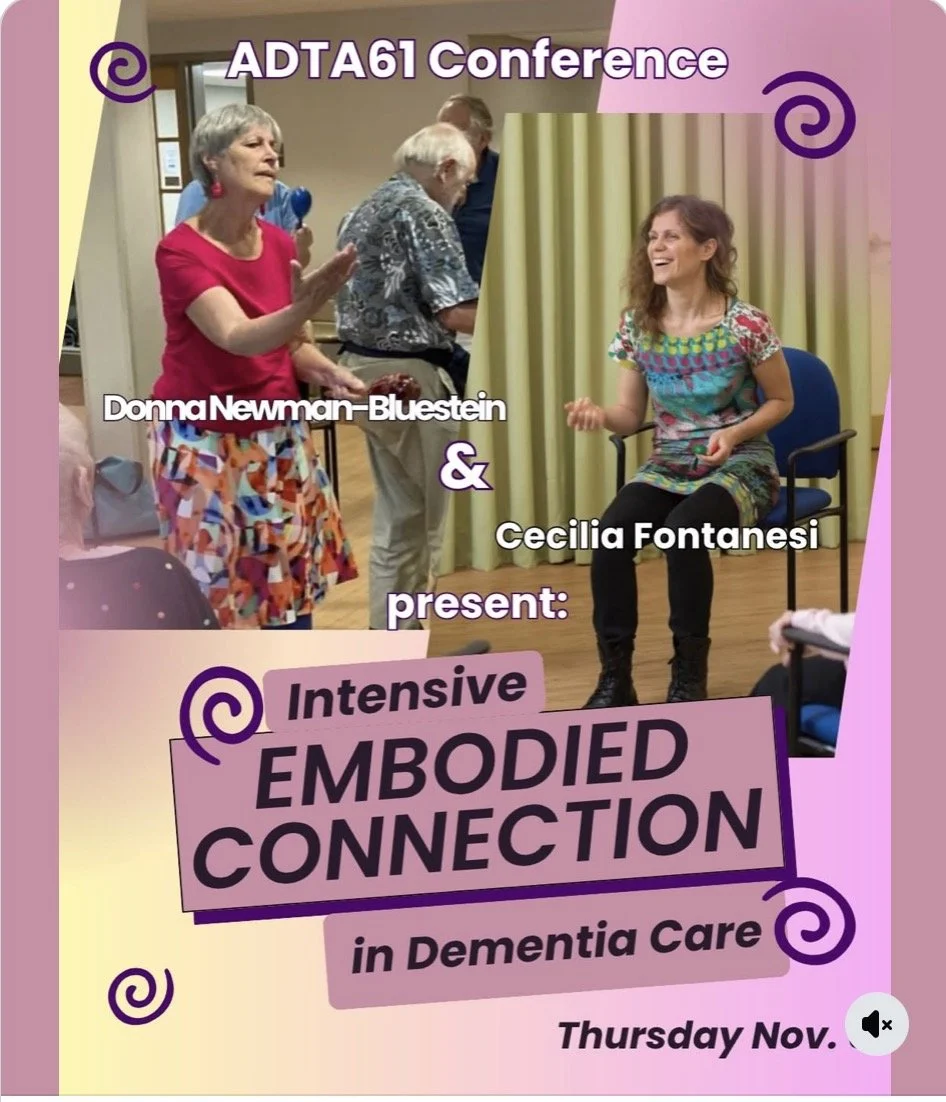
I am very much looking forward to presenting more about my work with colleague Dr. Cecilia Fontanesi on November 5 at the ADTA conference in Long Beach, CA. Sharing my love of this work is my calling.